
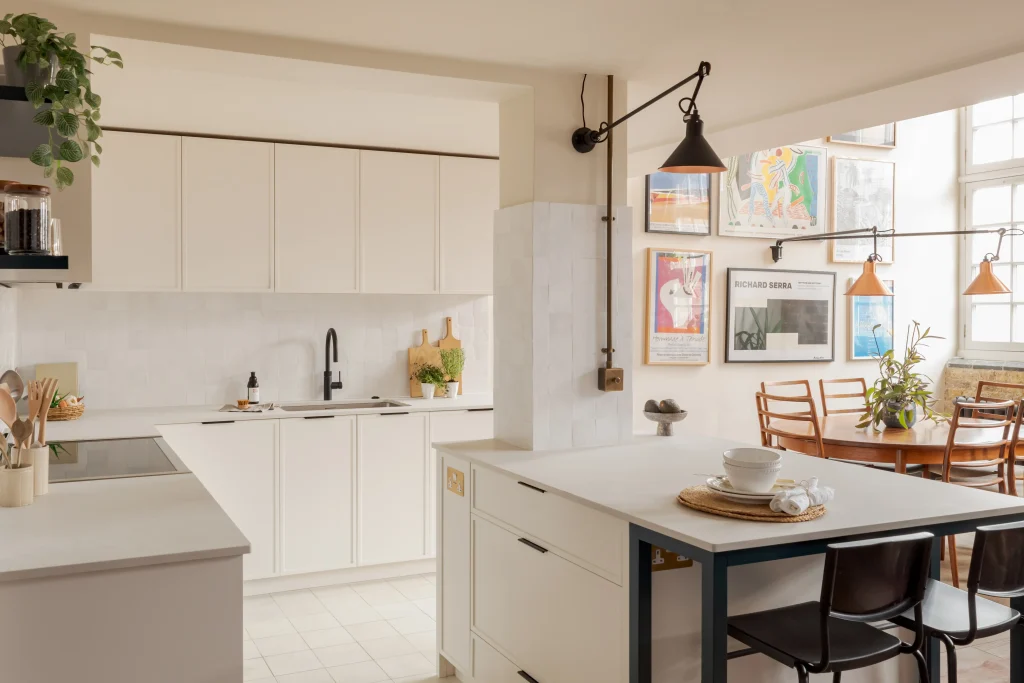
The honest answer is that they are not really different versions of the same thing. A fitted kitchen is assembled from components that already exist. A bespoke kitchen is made specifically for the room it will go into, and for the people who will use it.
Whether that distinction matters depends on the home, the brief, and how long the kitchen needs to last.
What a Fitted Kitchen Actually Is
Fitted kitchens are built around standard cabinet sizes. Doors, worktops and appliances are chosen from a set range, combined and installed to suit the room as best the dimensions allow.
The approach works well in spaces built with standard proportions in mind, and there are well-made fitted kitchens at the higher end of the market. The problems tend to emerge in rooms that were not designed with standard units in mind. A chimney breast that sits awkwardly. A ceiling that drops at one end. An alcove that falls between two standard widths. In those situations, the compromises start to show.
What a Bespoke Kitchen Is
Nothing about a bespoke kitchen exists before the project begins.
Cabinet dimensions, storage layout, door profiles, material choices. All of it is developed in response to the room and the brief. The cabinetry is made to order, which means lead times are longer and the cost is higher. What that process delivers is a kitchen that uses the space properly, including the parts that standard units cannot reach, built to a specification the homeowner has chosen rather than one a manufacturer has predetermined.
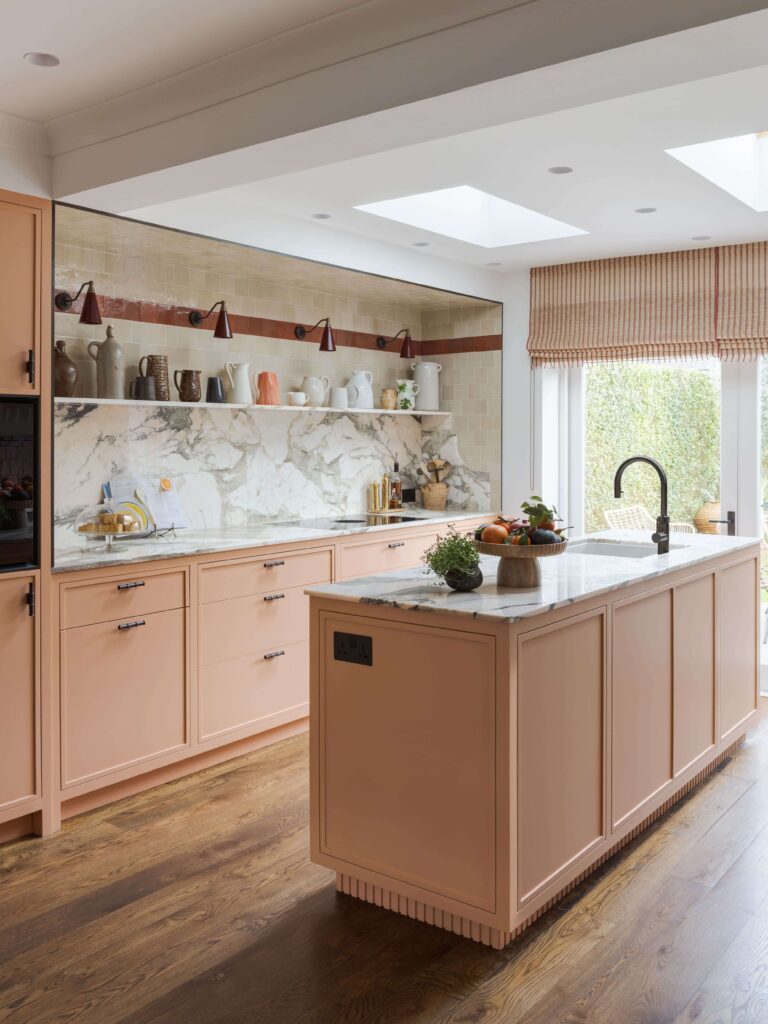
But bespoke is not only about fit and dimensions. Each kitchen is unique. The design is a considered mix of styles, materials and details that reflects the household and the home it belongs to. There are no preset options to choose from, no catalogue to work through. Every element is drawn and specified individually for the project. In some cases, samples are made specifically to confirm a finish or detail before production begins. That level of care is part of what the process involves.
It is a different process, not simply an upgraded version of the same one.
The Practical Differences
Fit
Standard units accommodate standard rooms. A great many rooms in this country are not standard, particularly in period houses, extensions and loft conversions. Bespoke cabinetry is made to the dimensions of the room as it actually is, which means chimney breasts, sloping ceilings and irregular corners are accommodated rather than worked around.
Build quality and longevity
Bespoke kitchens are generally built to a higher specification. Carcasses tend to be thicker, the joinery more considered, the fittings better chosen. The result is a kitchen that ages more slowly and handles daily use more reliably.
Most kitchens in the UK are replaced roughly every ten to fifteen years. A properly made bespoke kitchen tends to last considerably beyond that. Over the life of a property, that difference in lifespan changes how the cost comparison looks.
Cost
A fitted kitchen from a mid-range supplier, including appliances and installation, typically falls somewhere between £10,000 and £25,000. Bespoke starts higher and increases with the complexity of the brief and the materials chosen.
Part of the reason bespoke costs more is the design process itself. There is no preset software with ready-made boxes to place in a room. Every element is drawn and designed individually. Where specific finishes or details require confirmation before production, samples are made for the project. This takes considerably more time than configuring a standard range, and that time is reflected in the cost.
The comparison is not as straightforward as it looks on paper. What a kitchen costs at the point of purchase is one number. What it costs per year of use, taking into account how long each option is likely to last, can tell a rather different story.
When Fitted Makes Sense
A fitted kitchen is a reasonable choice when the room suits standard proportions, when the budget does not extend to bespoke, or when the plan is to move within a few years. A well-chosen fitted kitchen can be a practical and considered decision.
The important thing is to understand what the format can and cannot do before committing to it.
When Bespoke Makes Sense
Bespoke tends to be the more considered choice in older or more characterful properties, where standard units would sit awkwardly against the architecture. It is also the natural route for households with a specific brief: a particular layout, an unusual storage requirement, a finish or material that no standard range offers.
And for families who use the kitchen hard, every day, the durability of a properly made bespoke kitchen tends to justify the initial investment over time.
Is it Worth it?
That depends on what is being weighed.
If the room suits standard dimensions and the plan is to move in a few years, a well-made fitted kitchen may serve the purpose perfectly well. If the space is more demanding, the brief more specific, or the intention is to stay for the long term, bespoke is usually the more considered investment.
The question is not really which costs less now. It is which one will still be performing well in fifteen years.
Frequently Asked Questions
What is the difference between bespoke and fitted?
A fitted kitchen is assembled from pre-made standard-sized components. A bespoke kitchen is designed and built specifically for the room it goes into, to dimensions and specifications chosen by the client. The difference is in how each is made, how well it fits the space, how long it lasts, and what it costs.
Is a bespoke kitchen worth the extra cost?
For homes with non-standard layouts, or for households planning to stay long term, a bespoke kitchen tends to represent better value over time. A well-made bespoke kitchen will typically outlast a mid-range fitted one by a significant margin, which affects how the cost difference looks across the life of the property.
How much more does bespoke cost?
A mid-range fitted kitchen including appliances and installation generally sits between £10,000 and £25,000. Bespoke starts higher and varies with the scope of the project. The gap is real, but so is the difference in what each delivers.
Can bespoke work in any room?
Yes. That is rather the point. Bespoke cabinetry is made to the exact dimensions of the space, which means sloping ceilings, chimney breasts, deep alcoves and awkward angles are all accommodated properly rather than worked around.
How long does a bespoke kitchen last?
A properly made bespoke kitchen can serve a family well for 25 years or more. The actual lifespan depends on the quality of materials, how it is built, and how hard it is used. But durability is one of the things a well-made bespoke kitchen does considerably better than a mid-range fitted alternative.
In Summary
The choice between bespoke and fitted is not purely about budget, though budget is part of it. It is about whether the room and the brief are suited to what a standard format can actually deliver.
For many homes in South West London, Victorian terraces and Edwardian semis in particular, standard units involve more compromise than they are worth.
Kate Feather designs bespoke kitchens for families across South West London, including Teddington, Richmond and Twickenham. Get in touch to discuss your project.